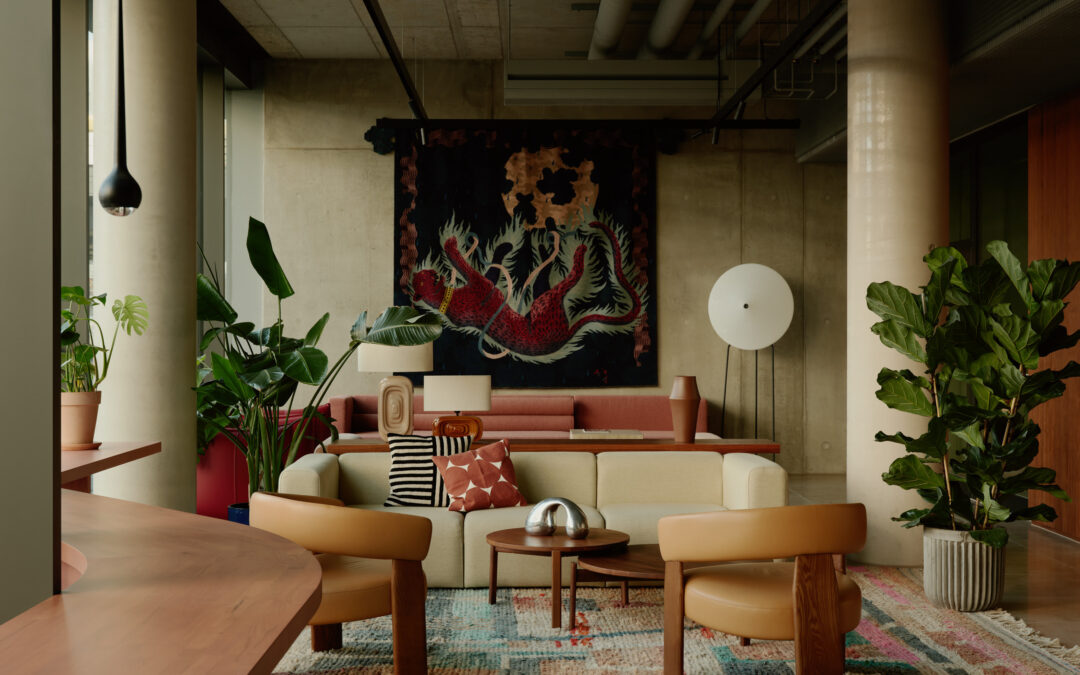
The shared amenity spaces at Berlin’s C1 office building draw on the warmth and ease of the home office — comfort, domesticity, and informality — while embracing the energy of a shared workplace. Here, social interaction and collective identity unfold within generously scaled furniture and welcoming environments designed to bring people together.
Bruzkus Greenberg draw on references from hotel lobbies, cafés, bars, and restaurants, using domestic furniture, varied lighting conditions, and differentiated atmospheres. This approach reflects the logic of the sharing economy: the shared amenities offer the kinds of spaces and experiences that exceed what individuals can reasonably have in their home offices.
Mixing bespoke and vintage furnishings with curated off-the-shelf products, the shared settings offer a rich combination of warm and cool to create colorful, material-rich spaces. The design language is reduced but opulent. By combining their expertise in hospitality, residential, and workplace design, Bruzkus Greenberg create shared amenity spaces that are comfortable, contemporary, and social.

At C1, six floors of conventional office space are anchored by two lower levels devoted entirely to shared amenities, forming a “third place” within the building. As employees return to the workplace, they demand more than a functional desk; they seek environments that nurture both performance and well-being. These collective spaces support focused work, teamwork, relaxation, and informal dialogue.
The spatial separation between communal floors and private offices enables tenants to customize their workspaces while relying on high-quality shared environments that exceed what individual offices typically provide.
The overall spatial strategy proposes a combination of enclosed rooms with controlled acoustic boundaries and open areas that define space and scale with furniture. Two dedicated floors of shared amenity spaces are located below six floors of conventional office space, and operate as a “third place” for the building tenants.


In order to make the space truly unique, Bruzkus Greenberg designed a line of sofas and tables for the lobby spaces. Using custom furniture avoids the impression that a lobby is furnished by a particular furniture brand – which can result in something predictable and generic.
The bespoke furniture creates a line of products that share a common aesthetic but are finished with different colors and materials. The sofas and chairs are finished with plain and textured fabrics and have end panels that are fabric-wrapped or exposed wood in different species; the tables are made from different stones and wood species.
To make the settings feel more unique, these original sofas and tables are positioned together with curated vintage pieces and less-seen off-the-shelf furniture. The aesthetic is unified but varied.

The shared amenity spaces include common areas like comfortable lounges that are designed with domestic furniture, varied lighting conditions, and differentiated atmospheres. These kind of shared amenity areas offer employees real choice in where and how they work, avoiding the perceived drawbacks of standard “offices” limited to rows of desks. Mixing bespoke and vintage furnishings with curated off-the-shelf products, these common areas offer a rich combination of warm and cool to create colorful, material-rich spaces.

The design offers common spaces with atmospheric choices that are rarely found in a home office. There are a variety of comfortable and contemporary areas to choose from to work or relax or have a conversation – more like a hotel lobby than a usual space-efficient “office.”

Green stone on the floor and on the built-in furniture area marks the entrance to the office building. The reception area is a space where you are welcomed with a smile, where you can get a coffee, where you can get your mail, and where you are invited to go into the courtyard, down to the other common areas downstairs. The interior architecture of the space is a combination of built-in and freestanding elements that divide a large open space into comfortably scaled rooms.

Built-in arena seating step down to a courtyard that connects to lower floor common rooms. The same stone flooring extends from the arena into the stepped courtyard, linking the interior and exterior spaces. At the far wall are twin chairs designed by Bruzkus Greenberg. The swiveling chairs are covered with fabric printed with tiger stripes, adding warmth to the exposed concrete room.

Steps in the courtyard link shared amenity spaces on the ground floor to those on the lower level. The downstairs spaces include a conference facility with meeting rooms of various sizes, break-out areas, a bar, a cinema, and a work-out/yoga room.

At the core of the project lies a simple but fundamental question: why would people choose to work in an office building at all? Bruzkus Greenberg address this question by offering environmental choices that cannot be replicated in the home office. The common spaces at C1 offer building tenants places to get away from their upstairs offices to work, to think, to meet, to have coffee, and to feel a generous sense of openness and productivity. The settings offer tenants the choice to work in different ways than in their usual shared “office” – or their home office.
Clear glazing is mixed with mirror on the fire wall to connect all of the shared spaces on the ground floor. The two kinds of glass finishes work together to unite shared amenity spaces on either side of a hidden concrete fire wall.
While it has become more and more common for landlords to provide shared programmatic amenities as a benefit to their tenants, the difference at C1 is the attention to design that the amenities have been given. The spaces are intended to feel more comfortable than the usual office lobby. They are designed to invite you to sit and work in a comfortable way. By mixing freestanding furniture pieces with built-in elements, comfortable rooms are created within the larger room, offering different ways to work.


This work is licensed under a Creative Commons Attribution-NonCommercial-NoDerivatives 4.0 International License.